

Emissions producers ranging from oil-and-gas rigs to utilities to manufacturers will be asked to pay more in fees for the third year in a row in 2027 in order to increase the revenues that state regulators need to permit and monitor their facilities.
Colorado Air Quality Control Commission members agreed Thursday to schedule a February rulemaking hearing on raising fees for facilities subject to state Regulations 3 and 7. The changes to three existing fees and addition of one new fee are expected to raise $2.5 million more for the Air Pollution Control Division.
That total is significantly lower than the $13.5 million in fees that the AQCC voted to raise in May or a smaller fee hike approved one year before that increased several commonly paid fees by 50% to 67%. But business leaders continue to express frustration at being asked to pay more while major permitting backlogs remain over two years long, despite the higher fees being dedicated in part to staffers assigned to review permit applications.
State law directs that stationary-source-control programs in the APCD — those that permit sources of emissions, measure pollutants and enforce compliance — must be funded by the companies that are being permitted. While fee increases the past two years closed the gap between costs of those programs and the amount of money available to fund them — a gap caused partially by a cut in general-fund tax revenue going to them in recent years — there continues to be a $7 million deficit.
A quartet of emissions fee changes
The fee increases that APCD will seek in February total only $2.5 million because some of the gap will be funded by fee increases approved in May that don’t take effect until 2027, explained Stefanie Shoup, APCD deputy director of regulatory affairs. The changes proposed Thursday include fee increases ranging from 3% to 29%, an expansion of an existing fee and the creation of a new fee for companies that request exemptions from certain reporting.
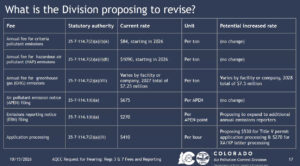
A chart created by the Colorado Air Pollution Control Division explains the proposed changes in fees.
The biggest proposed hike is to the fee for processing Title V permit applications — those required by stationary sources emitting at least 25 tons per year of regulated air pollutants along the northern Front Range (which is in severe nonattainment of U.S. Environmental Protection Agency ozone standards) or 100 tons per year in the rest of the state. The per-hour permit-processing fee for those sources — which range from oil-and-gas rigs to power plants to grain-elevator operators — would rise from $410 to $530 under the proposal.
Annual fees for greenhouse gas emissions that are charged to permittees that generate more than 25,000 tons per year of carbon dioxide equivalent would climb from a cumulative $7.25 million to $7.5 million under the plan. The exact amount charged to each emitter will vary, as the fees are pooled and divided proportionally among reporting companies based upon the proportion of billable emissions for which they are responsible.
New entities would be affected by fee revisions
A third proposed change would expand the fee required to be paid by industrial or commercial facilities along with emissions reporting notices to a new group of reporters — data centers that employ emergency or backup generator engines. Large centers can use 100 or more of these engines to ensure power is continuously flowing, and APCD charges a $270 fee for notices that must be filed for each of these emissions points, with each generator being considered a separate point.
Finally, APCD leaders on Thursday proposed a new $270 fee for processing applications for exemptions from filing Air Pollution Emission Notices. A wide category of activities can be exempt from these notices now if they apply to the state for documentation of their exemptions. Those activities range from dry-cleaning opeartions to certain diesel-engine usages and from residential-structure construction to battery recharging areas.
While APCD leaders proposed those four fees for revision, AQCC leaders can adjust the level of fee changes or even could adjust which fees the state will raise. They just must adjust fees so that the APCD has enough revenue to sustain its stationary-source-control operating budget, which is set by the Legislature.
APCD leaders explain the need for more fee hikes
If approved, the new fees would take effect on April 14 — about two months after the February rulemaking — and likely would start hitting companies when they submit applications or reapplications for permits by July 1, the start of the state’s fiscal year. Shoup told AQCC members that the increased revenue that is expected to be raised would cover what is needed by the programs for the 2028-29 fiscal year.

Colorado Air Quality Control Commission member Dan Blankenship asks a question about proposed fee changes during a hybrid meeting on Thursday.
AQCC Commissioner Dan Blankenship, who had expressed concern with the most recent fee hikes passed earlier this year, questioned why the commission is being asked to get more revenue from companies once again. Shoup explained that APCD leaders always had envisioned dividing these increases up over three years so that they would not hit companies all at once.
In addition to fee changes, APCD leaders also propose several changes in the way that emitters are regulated under state law.
Regulatory changes around emissions sources under consideration too
The proposal would eliminate every-five-year reporting now required with APEN submissions, as it is duplicative of annual reports that have been adopted more recently for emitting entities.
But regulated entities that now report the annual pollutant output of emitting equipment would be required in the future also to report all potentially reporting equipment, even if it were not active that year and not responsible for emissions. That is so that the state can note the presence of such equipment, which before was captured typically in the reports that were filed every five years, Shoup said.
Also, the division, under the new proposal, would require use of APCD-required protocols for calculating emissions reductions or generating credits for carbon-capture-and-storage projects. State leaders have said the use of carbon capture is needed to reach emissions-reduction goals, particularly in hard-to-decarbonize industries.
The new fees, when added to existing fees, are expected to generate about $50.8 million a year for stationary-source-control programs, officials have said. Business leaders, who have been waiting to learn the details of the new and raised fees, are likely to ask once again for some proof that the increased revenue can reduce the time it takes for the division to review permit applications.