Colorado won’t become the first state to make large employers help pay workers’ Medicaid benefits, after progressives and conservatives on a Senate committee agreed Thursday that the plan carried too many legal questions and potentially unintended consequences.
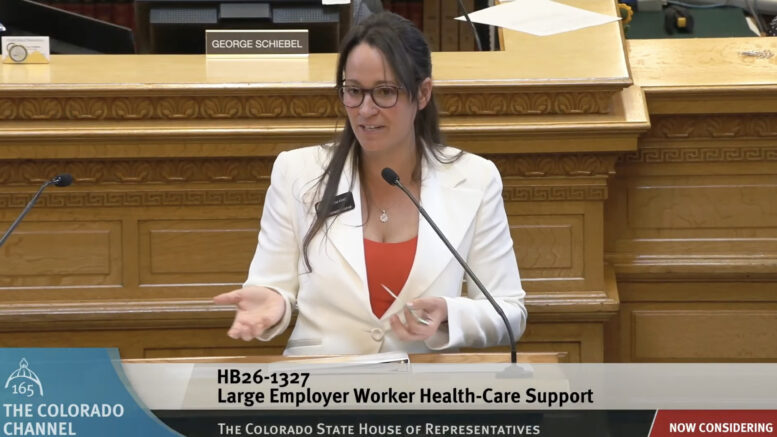
Of all the big ideas debated by the Legislature this session, House Bill 1327, sponsored by Rep. Lisa Feret of Arvada and fellow Democratic Sen. Kyle Mullica of Thornton, was among the boldest. It tried to address both the issue of unsustainable spending increases in the state Medicaid program and the concern that taxpayers are subsidizing health care for wealthy corporations with many part-time workers on the public health-insurance program.
Under the plan, companies with more than 500 part-time workers on Medicaid — fulltime workers earn too much to qualify for the insurance program, even at minimum wage — would have to pay $2,300 annually for each employee receiving the public benefits. That number is half of the annual cost of services for the average Medicaid recipient, and the money was set to go into a newly created enterprise to boost reimbursement rates for providers and try to get doctors to see more Medicaid patients.
Trey Rogers, the legal counsel for former Gov. Bill Ritter now representing the Colorado Retail Council, argued the structure of the enterprise violated the Taxpayer’s Bill of Rights. Enterprises must provide services to payors in exchange for fees, and the boost in funding for Medicaid wouldn’t benefit payors directly, nor was it a required voluntary transaction, as companies who did not pay the fees could have been fined, he said.
Business pushback against plan
Business leaders like the retail council’s Katie Wolf also warned that by threatening fees and fines to major employers, with some companies estimating bills in the tens of millions of dollars, it created an incentive for them to reduce their part-time workforce. And more than just a few of those workers are individuals who limit their hours to qualify for Medicaid because they or family members may have rare and expensive medical conditions that make it difficult for them to obtain affordable private-market insurance.
The latter argument seemed to fall flat as the bill advanced through the House, though it passed by just a 35-30 vote after eight Democrats across the ideological spectrum joined with Republicans in opposing it. But when Katherine Wallat, legal director for the Colorado Center on Law & Policy, made the same argument to the Senate Finance Committee on Thursday, it seemed to garner a lot of attention.
“The bill creates an incentive to ensure that fewer Medicaid enrollees are on the payroll,” she said, predicting that companies wanting to avoid new payments would steer clear of hiring lower-income and disabled workers. “These impacts would undermine the bill.”
Feret added an amendment in the House specifying that when calculating companies’ eligibility for the fees, state officials would count only income-qualified Medicaid recipients, not those on the public program because they are disabled. However, Wallat argued that the wording of the bill did not exempt all classes of disabled individuals, and that could serve to work against their gaining and keeping employment.
A small number of companies would have been affected
It was one of several amendments that Feret added to try to address questions about the bill — changes that included allowing employers to let part-time workers buy into their health plans and letting the enterprise board reduce or suspend fees if they were on track to produce more than $100 million in revenue in the first five years. She also delayed implementation of the program until 2028, seeking to give the state and employers time to get ready to implement it.
The bill sought to exempt a range of employers, including governments, nonprofits, franchisees and workplaces operating under collective bargaining agreements negotiated by unions. Feret estimated it would have applied to just 12 employers in Colorado: Amazon, Dollar Tree, Express Employment Professionals, the JBS USA plant in Greeley, Lowe’s, Natural Grocers, Ross, Target, The Home Depot, TrueBlue, Walgreens and Walmart.
But all her efforts, including extensive conversations with the business community, could not get business leaders on board with an idea that a select group of companies was being asked to help fund a Medicaid program whose budget has ballooned 8.8% annually for the past 10 years, even as enrollment is largely flat. Colorado Chamber of Commerce Senior Vice President of Governmental Relations Meghan Dollar told the House Finance Committee on March 30 that the state was already an outlier in terms of its high cost for doing business and said the fee would erode its economic competitiveness further.
Discussions about Medicaid to continue
Senate Finance Committee members voted down HB 1327 by a 7-2 margin on Thursday, with four Democrats joining the committee’s three Republicans in opposing it. Sen. Cathy Kipp, D-Fort Collins, said she was for the idea before groups like CCLP convinced her of its faults, and Sen. Adrienne Benavidez, D-Adams County, joined with several Republicans in arguing that it would violate TABOR.
Mullica acknowledged just before the vote that one of his biggest aims was to get a conversation going about new ways to fund Medicaid and to make sure that Colorado taxpayers aren’t subsidizing the “largest and most profitable employers.” And the amount of support that HB 1327 gathered this session indicates that conversation likely isn’t done.
Another measure that reached draft bill status and circulated around the Capitol but never got introduced had sought to tap a similar funding source to help with Medicaid costs. The proposal from Rep. Yara Zokaie, D-Fort Collins, would have sent to the voters an initiative to raise the level of taxable income of companies with at least 250 employees by the amount of state public-assistance payments attributable to those employers’ workers.
With Medicaid continuing to grow at twice the rate of state revenue, legislators made cuts equal to hundreds of millions of dollars to the program this year, including reducing provider reimbursements and capping yearly benefits for some services. Program directors say that service costs have risen at unexpected rates, while a growing number of legislators have expressed concerns about the amount of documented fraud and perceived waste in the program, which uses a larger portion of the state budget than any other program.