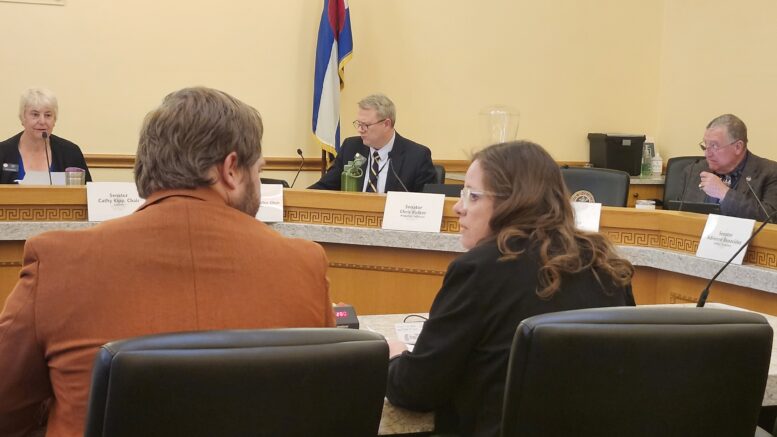
A Senate committee OK’d two bills aiming to get more hail-resistant roofs onto on Colorado homes Tuesday, arguing that both could provide pathways to slowing skyrocketing homeowners’ insurance rates that compound the state’s housing affordability crisis.
Senate Bill 155 would assess a 0.5% fee on all homeowners’ insurance policies in Colorado and use it to fund a grant program to help homeowners replace roofs with those that are hail-resistant. The bill, sponsored by Democratic Sens. Kyle Mullica of Thornton and Janice Marchman of Loveland, would bar insurers from passing the costs along to customers and would require they report on the impact on rates generated as more hardened roofs go up.
SB 49, from Democratic Sen. Marc Snyder of Manitou Springs and GOP Sen. Lisa Frizell of Castle Rock, would allow creation of tax-advantaged catastrophe savings accounts into which residents could put up to $50,000 annually to save for hail-resistant roofs. The money also could be used to pay deductible costs stemming from hail or wind events, and the bill exempts interest earned by the accounts from income tax.
Both bills are the direct descendants of last year’s failed SB 25-1302, which sought to impose 1% fees on all homeowners’ insurance policies and split the revenues between two new enterprises to mitigate against wildfire and against hail damage. Snyder was the sponsor of that bill and decided that he wanted to try to address the issue this year without imposing fees on policies, while Mullica was a key vote to kill the bill because he worried about adding fees while the cost of living is rising.
Two approaches, two different sets of backers and critics
SB 155 and SB 49 offer more narrow scopes that are limited to hail damage, which was the largest contributor to homeowners’ rates that rose a nation-leading 18% in 2025, as the weather phenomenon has generated more than $5 billion in claims over the past decade. An amendment Tuesday to SB 49 removed an attempt in the bill to expand Natural Disaster Mitigation Enterprise wildfire-mitigation grants given to local governments to individual homeowners and homeowners associations.
The underlying theory behind both bills is this: The more Coloradans who install hail-resistant roofs, the fewer claims that will be filed when hailstorms hit and the less that insurers will have to raise rates to compensate for payouts. Property and casualty insurers endured so many claims that they lost money in Colorado in 8 of the 11 years leading into 2025, necessitating the rate hikes that bills like SB 49 seek to slow, Colorado Chamber Foundation Executive Director Rachel Beck told the committee.
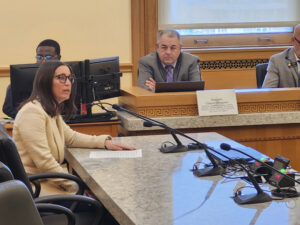
Colorado Chamber Foundation Executive Director Rachel Beck testifies Tuesday for Senate Bill 49.
SB 49 passed the Senate Finance Committee on a 7-2 margin, while SB 155 advanced on a Democrat-led 6-3 party-line vote. Both measures are headed to the Senate Appropriations Committee, which will scrutinize their costs as the state faces a $1.5 billion shortfall.
Neither bill engendered citizen opposition after the amendment to SB 49 removed the expansion of grants from the already oversubscribed enterprise to fund wildfire mitigation efforts. Supporters from the housing and insurance industries and from local governments lauded the proposals’ efforts to stop the escalation of insurance costs, which have added to rising home prices to make Colorado one of the most expensive states to live.
How the efforts could impact homeowners’ insurance premiums
“When housing costs become unaffordable, it directly impacts workforce recruitment and retention,” said Jeff Thormodsgaard, vice president of government affairs for the Colorado Springs Chamber and Economic Development Corp., speaking for SB 49. “This is smart, preventative policy that reduces costs.”
Snyder and Mullica, who both sit on the finance committee, supported each other’s bills. However, both bills also produced legislative pushback that could impact their paths to Gov. Jared Polis’ desk.
Sen. Adrienne Benavidez, D-Adams County, complained that the new tax-advantaged savings accounts in SB 49 contained an abundance of “fraud flags” that could allow people to seek tax benefits without using them for their stated purpose. And Sen. Chris Kolker, D-Centennial, argued that the accounts would only benefit wealthier individuals, as average homeowners struggling with the cost of living wouldn’t be able to put money aside to replace their roof at a high cost.
“This is out of pocket to people. They have to come up with whatever that cost is,” Kolker said before he and Benavidez cast the two “no” votes on the bill. “That’s great. But this isn’t to me going to help people who are just getting by and who have families and are saving for college.”
Support and pushback on savings accounts
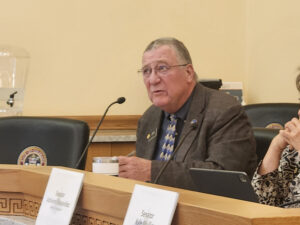
Colorado state Sen. Marc Snyder questions a witness during Tuesday’s Senate Finance Committee hearing.
Snyder pushed back on Benavidez’s concerns, noting that the bill directs specific actions, including sampling of catastrophe savings accounts, to give oversight to the program and also directs the Office of the State Auditor to examine program effectiveness. Nikolaus Remus, advocacy engagement director for the American Institute of Architects’ Colorado chapter, pushed back on Kolker by saying the accounts offer a way for everyone to save money — and take actions that further save money by slowing premium increases.
“Even a modest tax reduction makes the difference for these expensive efforts,” Remus said. “If a homeowner wants to be proactive and take mitigation steps, this will make (premiums) more affordable.”
Mullica, meanwhile, hung his bill on the same basic idea that significant hail-resistant roof uptake would push down rate pressure across the state. But the difference between SB 155 and last year’s failed effort, he emphasized, was the provision that insurers could not pass the new fee along to policyholders — a provision that he said will prevent long-term costs of bolstering hail protections from falling onto homeowners in the short term.
Another provision in the bill would require insurers to report annually to the Colorado Division of Insurance on the number of customers with hail-resistant roofs, the premium discount applied to those homes and a comparison of the frequency of claims for wind and hail damage for homes with and without such roofs. The division also would be required to conduct a study, funded by fee revenue, on what impact a high-risk insurance program could have on areas of the state at the highest risk for wildfire.
Impact of homeowners’ insurance fees?
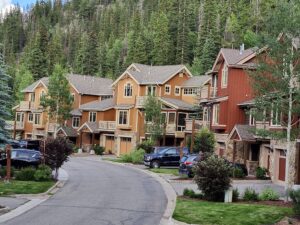
Homes that in areas of urban-wildland interface in Colorado face skyrocketing insurance costs and sometimes difficulty in finding insurance.
Several insurance-industry groups supported SB 155 despite the fee because they identified putting significant resources into hardening roofs as one of the few things the state can do to reduce the risk of premium-driving hail damage. Because rates are determined in part by the frequency and size of losses, a significant increase in roof protection can offset any cost increases that come with the fees, several said.
“This is an important step to stop looking for insurance solutions and to start supporting risk-reduction solutions,” said Dan Jablan, speaking for the Rocky Mountain Insurance Association.
All three Republicans on the committee still voted against SB 155, continuing a trend of opposing bills that create new enterprises using fees. Party leaders repeatedly have said that the proliferation of such enterprises is a workaround on the Taxpayer’s Bill of Rights prohibition on new taxes that are not approved by voters.
“This bill will not increase the cost to consumers,” Mullica emphasized. “There is a consensus that that the way we wrote this bill will actually lower the cost of insurance to the homeowners of Colorado.”
Several supporters of SB 155 referenced the Strengthen Alabama Homes program, a 15-year-old program in that state that offers grants to homeowners to make their dwellings more wind-resistant, funded by existing revenue from licensing and regulatory fees. That program hasn’t reduced homeowners’ insurance premiums — they still have more than doubled since its launch — but it has brought back insurers who previously had pulled out of areas of the state after heavy claims from tornadoes and hurricanes.
Fiscal notes could impact bills’ fate
One striking aspect of the bill hearings was the differing level of suspicion that some committee members leveled at Colorado residents and Colorado insurers. No one questioned when insurers said they would not pass the new fees along to customers, despite the industry coming under heavy criticism from some legislators in recent years for rate increases. However, Kolker and Benavidez suggested that they believe the new savings accounts would be rife with fraud from Colorado residents.
SB 155 is expected to raise $30.2 million for the Strengthen Colorado Homes Enterprise in the next fiscal year, then about $16 million a year after that as the fee is halved to follow state law limiting enterprises to raising no more than $100 million in their first five years. Democratic appropriations committee members aren’t likely to have problems with the bill, as it does not impact the general fund.
SB 49, meanwhile, carried into Tuesday’s hearing a $163,046 fiscal note for the budget year beginning on July 1 — a barrier that led Sen. Cathy Kipp, a Fort Collins Democrat who supported the bill, to predict it would not make it out of the appropriations committee. However, Snyder noted that nearly three-quarters of the estimated cost was based on the expansion of the Natural Disaster Mitigation Enterprise, which he removed Tuesday from the bill, and he said he would work to reduce or eliminate the rest of the proposed costs.
Colorado’s average annual homeowner’s insurance premium in 2025 was $3,412, according to consumer financial-services firm Bankrate — the eighth-highest rate in the country. The increasing number of natural disasters, rise in the severity of damage and boom in the price of materials needed to fix damaged homes has contributed to the upward trajectory of policy costs.