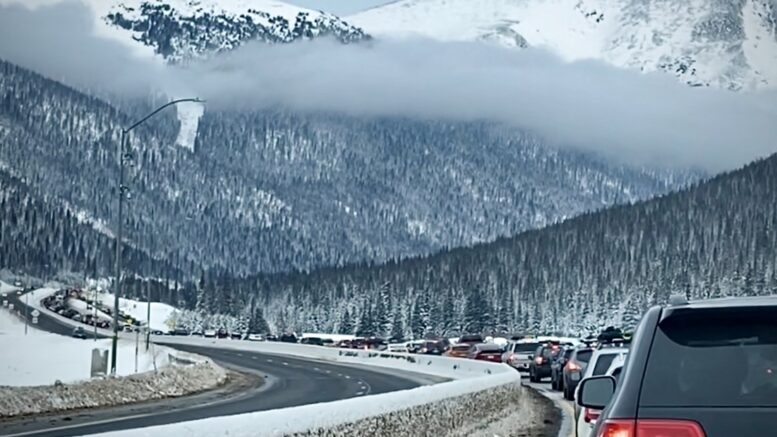
Just six days after its introduction, Colorado House members passed a bill Thursday to cut road funding in the general-fund budget by about $700 million annually to offset the transfer of that much money to roads that a November ballot initiative proposes.
House Bill 1430 is raising the temperature level of debates both in committees and in the legislative chambers. Opponents say it’s “anti-democratic” and “cuts the knees out” from under the proposed Initiative 175, while the bill’s sponsors say it’s necessary because Initiative 175 backers aren’t speaking honestly as they gather petition signatures about the tradeoffs their plan would force.
With both sides revving their engines, the late bill is becoming the most hotly debated topic as the General Assembly speeds toward its Wednesday adjournment, particularly as a long-anticipated artificial-intelligence regulatory bill is moving ahead with little opposition. And HB 1430 could elevate the debate around the proposed initiative to mountain-high levels on a ballot featuring an open gubernatorial race and a U.S. Senate where it otherwise might have struggled to gain attention.
Initiative 175, backed by a coalition led by the Colorado Contractors Association, would require that the state put two-thirds of the sales tax collected from vehicle and auto-parts sales to maintenance, construction and operations of public roads and highways. As there is no legislative set-aside of any portion of sales-tax revenue for this purpose now, it’s expected this will move $690.4 million in general-fund and cash-fund money to this purpose in its first full year, forcing legislators to reprioritize their spending.
Why the bill on road funding is coming forward
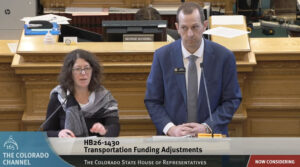
Colorado state Reps. Emily Sirota and Andy Boesenecker explain their House Bill 1430 in the chamber on Wednesday.
After a second straight budget in which the General Assembly has had to plug a more than $1 billion shortfall, majority Democratic leaders say this is too much to ask and have devised an alternate plan in the form of HB 1430. It would cut existing transportation funding in several ways such that the $700 million transfer would end up being a wash and would allow them to avoid cuts to health care, K-12 education and other services that otherwise would lose money to roads under Initiative 175.
HB 1430 would eliminate a $100 million general-fund transfer for road-construction debt service and cut an annual $100 million transfer to the State Highway Fund, backfilling both with required Initiative 175 funds. It would reduce the gas tax from 22 cents to 14 cents per gallon and the special fuel excise tax from 20.5 cents to 13 cents a gallon. And it would reduce vehicle-registration and road-safety surcharge rates by 38% as well as cutting the road-usage fee that functions like an extra gas tax from 6 cents to 4 cents per gallon.
This is necessary, said cosponsoring Democratic Rep. Andy Boesenecker of Fort Collins, because the alternative is cutting more funds to Medicaid services or to schools after several years when they’ve already been pinched. He and cosponsoring Democratic Rep. Emily Sirota of Denver told the House Transportation, Local Government and Housing Committee Tuesday that Initiative 175 is a siloed attempt at a money grab to benefit one interest group when legislators must consider the holistic picture of how to pay for all services needed by Coloradans.
“As anti-democratic as it gets”
“I do take offense that the needs of the state are being pitted against this measure,” Sirota said. “I think it needs to be a collective and collaborative conversation about how we can fund transportation, but transportation isn’t the only need that we have … It’s hard to have this conversation while we are being held hostage by this particular initiative.”
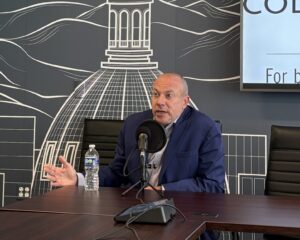
Colorado Contractors Association CEO Tony Milo speaks about road funding on the “Colorado Chamber Office Hours” podcast.
Tony Milo, CEO of the contractors’ association, asserted that it’s the people who have been signing petitions to get this initiative onto the ballot — a process that is about 75% complete — who are really being held hostage. Rather than letting voters determine if road funding should be a higher priority, the Legislature is ensuring that were Initiative 175 to pass it would produce no new funding for roads but instead hold that funding steady against voters’ wishes.
Several Democrats on the transportation committee pounded Milo with questions about which health-care services he would cut if the initiative passes, to which he answered that the transfer is equal to 2% of a general-fund budget that grows 5% to 7% annually. No cuts would be needed, he said, but the Legislature would instead have to start putting a portion of its new money annually to fixing interstate pavement that Reason magazine ranked as the nation’s sixth-worst in urban areas and fifth-worst in rural areas.
“House Bill 1430 is the General Assembly saying they know better than voters how the money should be spent. It’s an end around the voters, and it’s as anti-democratic as it gets,” Milo told the committee. “The special interests are all here to protect their claim to taxpayer dollars. But who is not here is the average Colorado motorist, who relies on a safe, effective transportation system.”
Health care, teachers support bill

Jeff Tieman is president and CEO of the Colorado Hospital Association.
The two main groups that offered support for HB 1430 Thursday were hospital leaders and educators, the latter group expressing fear that cuts will have to come from K-12 schools. Colorado Hospital Association President/CEO Jeff Tieman noted that hospitals statewide are losing $150 million next fiscal year from the Medicaid provider-rate cuts the Legislature approved to balance the budget and said that with Medicaid patients making up half of the payer mix for some rural hospitals, any further significant cuts could cause some facilities to close.
“We understand the frustration with Colorado’s roads … But the mechanism matters,” Tieman said. “A measure that improves pavement while lengthening the drive to the nearest hospital is not a win for rural Colorado.”
While Initiative 175 backers can’t do anything about it if legislators pass HB 1430, Milo said in an interview for the “Colorado Chamber Office Hours” podcast that there is some silver lining. Even if the twin passages of the bill and the initiative were to keep Colorado road funding flat for the next three years, it would replace a declining revenue source for roads — the gas tax, which is receding because of electric and fuel-efficient vehicles — with a primary revenue source in the sales tax that increases annually as the state grows, he said.
A temporary change in road funding
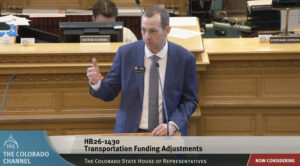
Colorado state Rep. Andy Boesenecker discusses HB 1430 on Wednesday.
The tax and fee levels that are cut in HB 1430 will return to 2026 levels again in 2030 under the bill, as that should give the state enough time to get past its current budget deficits and plan for how to absorb the $700 million annual transfer, Boesenecker said in an interview. But the next three years are critical ones to ensure other services are funded, particularly as analysts expect tens of thousands of people to lose health insurance in the coming years because of federal subsidy cessations and Medicaid eligibility changes, and the state must be able to offer safety-net services.
Milo argues that that when accounting for inflation, the amount of money that Colorado has put to roads hasn’t risen in 10 years, despite a growth in population and in vehicle miles traveled and a decline in road quality. Boesenecker countered that, particularly because of a road-funding package signed in 2021, the Legislature has put an average of $470 million a year in new funding into roads, bridges and transit, though primarily roads, for the past decade.
Several House Republicans joined Milo in offering choice words for the bill. Rep. Max Brooks of Castle Rock called the move “an effort to circumvent the voice of the voters” and said it “cut the knees out from underneath a ballot measure.” Rep. Rebecca Keltie said it is “a direct affront … to the intelligence of the people.”
Still a need for transportation-funding conversation
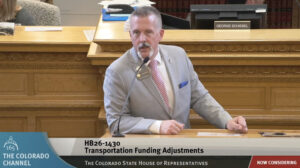
Colorado state Rep. Max Brooks criticizes HB 1430 in the House on Wednesday.
Boesenecker told the Colorado Chamber podcast that he believes there should be a conversation about how to boost road funding — he has supported the widening of Interstate 25 through Fort Collins, he noted — but not like this. The language of the ballot measure implies that there will be no cost to boost road funding without talking about from where legislators will have to get the money, and that isn’t a real discussion, he said.
“If we silo these efforts to say, ‘Well, the contractors want to go it alone to put a constitutional amendment on the ballot,’ what’s to say that the hospitals won’t do the same or the schools won’t do the same?” he asked. “I think there are unintended consequences of what 175 would do that would jeopardize long-term planning in our state.”
HB 1430 passed the House by a 42-22 vote on Friday, with all present Democrats except Rep. Bob Marshall of Highlands Ranch voting for it and all Republicans except Rep. Rick Taggart of Grand Junction, a member of the Joint Budget Committee, voting against it. It could get its first committee hearing in the Senate as early as today.