
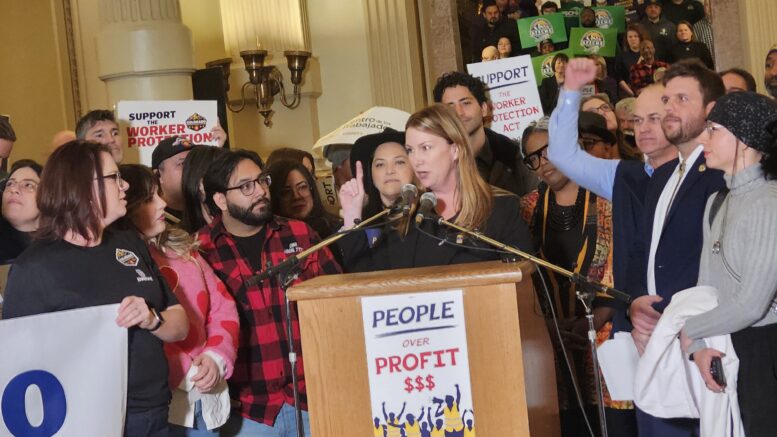
Gov. Jared Polis again vetoed a bill Friday that would have eliminated Colorado’s unique second election in the private-sector unionization process, saying that “both business and labor leaders missed an opportunity this year” by not negotiating a compromise.
It is the second year in a row that Polis took such an action, after the Legislature sent to him an almost identical measure to that which he nixed last year, when he said that the proposed changes could be detrimental to both labor and business. This year in his veto letter, he said he had hoped that business and labor would be willing to negotiate a “long-term and durable agreement” after his 2025 action, and he expressed disappointment that the two sides did not.
Business leaders noted repeatedly that unlike last year, labor leaders never came to them seeking to negotiate, sending the signal that they felt this year’s effort was more of an election-year political statement than a serious attempt at policy change. Groups including the Colorado Chamber of Commerce, Colorado Restaurant Association and Associated General Contractors of Colorado testified on how easier unionization would drive up business costs, drive down Colorado’s competitiveness for jobs and allow a thin majority of staffers to force coworkers to pay union negotiating fees.
Labor leaders again argued that Colorado’s 83-year-old Labor Peace Act is the only state law governing unionization that requires two votes to organize effectively — a majority vote to form a union and a subsequent 75% vote to let unions take negotiating fees directly from paychecks. It is an unnecessary burden that allows employers to badger workers into rejecting union security during the period between elections and is a big reason Colorado has the lowest private-sector unionization rate of any non-right-to-work state, they said.
Veto follows Dems’ pleas to gubernatorial candidates
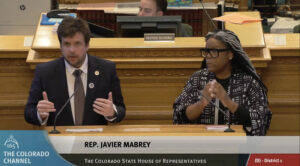
Colorado state Reps. Javier Mabrey and Jennifer Bacon explain their bill to undo the Colorado Labor Peace Act in March on the House floor.
While legislative Democrats did not seek to negotiate a compromise, they did pen a letter to Democratic gubernatorial candidates Michael Bennet and Phil Weiser last month after it became clear that Polis was planning to veto House Bill 1005, the new version of the bill. In a missive signed by 57 of the 66 General Assembly Democrats, they told the potential successors to the term-limited Polis that they have the power to fix the “unfair advantage to mega-corporations” that the Labor Peace Act grants and asked them to commit to supporting an unamended version of the bill.
All 66 Democrats in the House and Senate voted to pass HB 1005 over the “no” votes of every Republican in the two chambers. Both Bennet and Weiser have said that they support making it easier to achieve union security in Colorado, but neither has committed to backing the version of the bill passed in 2025 or 2026.
“Coloradans are ready to elect leaders who stand with working people instead of billionaire CEOs. That’s the leadership we’re prepared to work with to pass the Worker Protection Act,” said Stephanie Felix-Sowy, president of SEIU Local 105, in a news release Friday. “This bill is the most significant pro-worker labor reform Colorado has seen in generations and vetoing it after overwhelming support from workers and Democratic legislators is an assault on democracy itself.”
The nine Capitol Democrats who did not sign onto the letter to the candidates were Sens. Lindsey Daugherty and Kyle Mullica, plus House Speaker Julie McCluskie and Reps. Sean Camacho, Cecelia Espenoza, Lisa Feret, Bob Marshall, Jacque Phillips and Alex Valdez.
“This bill would have sent the wrong message”
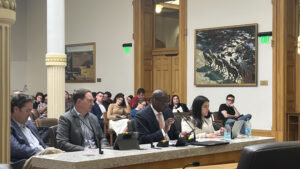
Employment attorney Stacey Campbell, third from left, speaks as part of a business panel opposing changes to the Colorado Labor Peace Act during a legislative committee hearing in February.
Business leaders celebrated Polis’ decision Friday, saying that the veto is a key step to protecting Colorado’s economic competitiveness at a time when the state is seeing business expand and relocate to other states because of high costs and overregulation.
Thanking Polis, Grand Junction Chamber of Commerce President/CEO Candace Carnahan told The Sum & Substance the veto acknowledges the negative impacts the change would have on employers and demands that such major changes happen only with consensus. Colorado Chamber of Commerce President/CEO Loren Furman lauded Polis for again recognizing that eliminating the second election would have removed the key safeguard that keeps one group of workers from forcing others to give up parts of their paycheck.
“Colorado’s Labor Peace Act is unique and has helped foster a business climate that supports job creation and economic growth while respecting the autonomy of employees,” Furman said. “At a time when employers are facing increasing economic uncertainty, this bill would have sent the wrong message to businesses looking to grow and invest in our state.”
Polis, however, laid blame at the feet of both sides in his veto letter, even as he criticized the legislation that marked his fifth veto of this session so far.
Polis warns labor fight will return next year
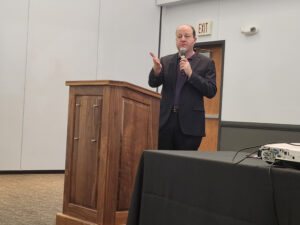
Gov. Jared Polis speaks at a regional talent summit in 2025 in Arvada.
He said the bill would allow “the bare majority” of workers casting ballots to decide to take money from all other workers, and he said the current formula also creates an incentive to unionize small firms almost exclusively, where achieving 75% agreement is easier. He reiterated he would support a modernized framework — he didn’t state in the letter what it should be but has suggested previously that reducing the 75% second-vote threshold should be on the table — to address some challenges identified by labor organizers.
However, Polis seemed to express more frustration this time around that a consensus was not reached under his oversight, saying that the likelihood this creates of the issue coming up again next year creates uncertainty for both workers and businesses. He insisted that the Labor Peace Act — unique among the 27 right-to-work states and 22 right-to-organize states — matters for Colorado’s economy and should be updated rather than scrapped.
“Changes to this law could have improved on the status quo for both sides and provided long-term stability and certainty, especially as we transition to the next gubernatorial administration,” the eighth-year Democratic governor wrote. “This year, both sides should have dropped their ideological dogmas and worked together benefit all of Colorado. I am dismayed that both business and labor leaders failed to do so.”
Then he added: “For these reasons, HB 26-1005 is disapproved and vetoed.”