
As Colorado economic-development leaders continue pushing to create more workforce-training programs to boost pipelines into in-demand jobs, they want businesses that hope to build new training facilities to apply for tax credits for that purpose.
The Opportunity Now Tax Credits, approved in the same 2024 law that launched the Opportunity Now Regional Talent Summits, offer credits on as much as 50% of the cost of land, buildings or equipment purchased and developed to create a new training site. The credits can be used through 2033, so a quick construction job is unnecessary, and companies involved in manufacturing, construction, clean energy, semiconductor-production and infrastructure-related fields all are eligible.
These credits are an offshoot of the Opportunity Now grant program that awarded $100 million over several years to coalitions of private-sector employers, educational institutions and government programs that created new training pathways. With so many pathways having been seeded to prepare workers, state officials hope now to boost investments in individual workplaces seeking to offer training.
“The Opportunity Now tax credits expanded our original efforts to move beyond direct training dollars,” said Misti Ruthven, director of talent innovation for the Colorado Office of Economic Development and International Trade. “What this does is help businesses to think about: ‘What do I need to expand?’”

Gov. Jared Polis cuts the ribbon on the CoorsTek Academy, which was funded in part by Opportunity Now grants.
How the program works
The program, which is accepting applications through Monday, is entering its second year. Last year, officials received more than $200 million in funding requests for an award pool of just $15 million, showing the desire from the business community to build out training facilities. Credits went to companies in sectors from semiconductor manufacturing to aerospace, and officials distributed them over a wide geographic swath, Ruthven said.
This year, OEDIT has just $7.5 million in credits to award that can be used beginning in the 2027 tax year because of a trigger in the original bill that cuts in half the credit pool in years when Colorado is under its Taxpayer’s Bill of Rights revenue cap. But rather than limit the number of credits it gives out if it again gets a large number of applicants, the state will issue credits for future years — those that can’t be used for at least another year — to companies that aren’t planning to begin building until after July 1, she said.
The law permits future awards of credits through the year 2033.
Interest is building among companies who have made initial investments in training programs — particularly those who received Opportunity Now grants — and now need space and equipment to supplement them.
A Golden company wants to grow to meet increased demand

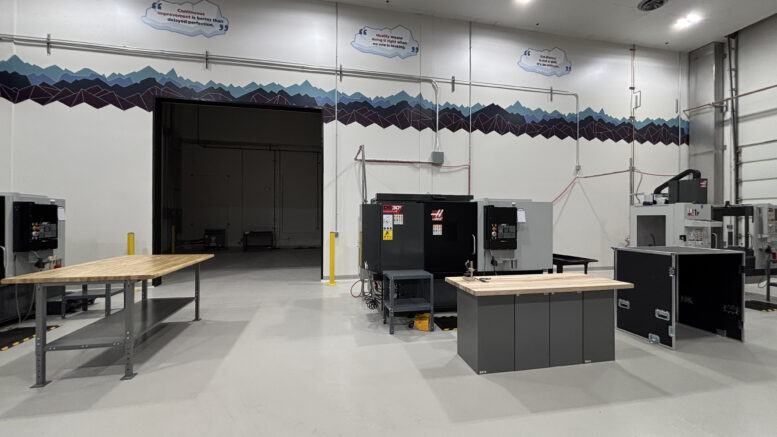
A look at the CoorsTek Academy, which helps to train workers across the advanced-manufacturing sector.
Golden-based ceramics maker CoorsTek, for example, received the largest Opportunity Now grant — nearly $5 million to launch a community advanced manufacturing training center, where it offers training for its workers and those of 21 other companies. The center has established partnerships with schools like Warren Tech and Red Rocks Community College, has built a career pathway for people to become maintenance technicians and is currently building another for computer numerical control program operators.
CoorsTek has seen interest in its product grow and now wants to build out a new physical space into which it can repurpose some of its equipment to use to train new workers and boost production, said Sean Grubb, the company’s director of technical training. So, it is looking to apply for credits to help fund that new training area, believing that a larger trained staff could boost its product lines and help it boost the economy via hiring.
“It could mean quite a lot in terms of setting up for the future,” Grubb said, noting that the community training program that CoorsTek has established has brought in a wide swath of attendees, including high-school students who could add to its future workforce.
Ruthven noted that Opportunity Now grant recipients can’t get tax credits for the same training project for which they’ve already received state aid. But she loves the idea of companies that have launched training programs wanting to invest in new training space or equipment, saying that is the big-picture impact that officials have sought through the Opportunity Now program.
Construction industry could benefit from workforce-training tax credits

Misti Ruthven speaks at the Opportunity Now Regional Talent Summit in Grand Junction in May 2025.
That’s likely music to the ears of Jeff Barratt, the president/CEO of the Associated General Contractors of Colorado, whose organization received a $2.8 million Opportunity Now grant in conjunction with Colorado Succeeds to expand its Project Scale work. That program allows the industry group to go into high schools and set up training programs in which students can learn construction techniques and pave pathways into careers — a program that’s established now in 92 schools and has served 5,000 students.
AGC too has turned its interest toward the tax credits, as both it and some of its members have talked about setting up in-house training facilities that can supplement the work of Project Scale and bring in mid-career professionals looking for a change. In-house training sites are particularly valuable for companies building pre-fabricated homes, as such indoor construction allows for more control of the work than an outdoor site and can let trainees spend time learning and then spend time working in the same day, he said.
“If we need 30,000 construction workers by 2030, that’s a big number,” Barratt said, pointing to estimates of the boost in laborers Colorado will require to meet its housing shortage and start to replace aging workers. “To get these tax credits to help build out the program would be a huge step.”
Range of industries eligible for training help
While some observers saw last year’s awards of tax credits as very focused on high-tech industries, Ruthven emphasized that the inclusion of critical-infrastructure sectors means that a lot of employers can benefit. That definition includes companies in industries ranging from communications to financial services and from agriculture and food to healthcare, according to the Cybersecurity & Infrastructure Security Agency.
While the deadline for submitting applications is approaching quickly, Ruthven emphasized that it should take no more than 45 minutes to fill out the form. Awardees will be announced in the coming months.
The Opportunity Now Tax Credits are part of a bigger push by Gov. Jared Polis’ administration to boost pipelines into in-demand careers at a time when employers cite a skilled-talent shortage as one of their biggest impediments to growing in Colorado. On Thursday, for example, a Transition Advisory Commission tasked with streamlining Colorado higher-education and workforce-development initiatives into one new state department held its first daylong meeting to discuss details for the new agency.