
Voters who agreed last week to raise the sales tax to fund construction of a Front Range Passenger Rail should start to see the first benefits of the initiative by 2029 and full benefits — 10 round trips a day — by 2032, district leaders say.
When completed, rail line will stretch from Fort Collins to Pueblo and could carry as many as 3 million riders a year, Front Range Passenger Rail District General Manager Sal Pace told the “Colorado Chamber Office Hours” podcast. It will feature 13 stops for a retrofitted Amtrak car, traveling at an average 79-mile-per-hour clip that might parallel traffic flow on Interstate 25 during low-congestion periods and outpace it during rush hour.
For business leaders, the train could serve two purposes. It could transport workers living in one part of the Front Range to a job in another part of it — anywhere from a Colorado-Springs-to-Denver commute to a shorter jaunt from Westminster to Union Station. And, if it is as popular as district leaders hope that it will be, it could start to pull some of the 200,000 cars per day that clog the most crowded parts of I-25 off of the highway as people chose to take the “Colorado Connector” instead.
Debate over how much rail will be used
Not everybody buys that there will be a significant migration of drivers becoming train riders; Independence Institute transportation center director Randal O’Toole noted that similar intercity trains in Utah and New Mexico are running at less than one-third capacity. But Pace, pointing to a Denver Regional Council of Governments study estimating that the congestion level of 5 p.m. rush hour through Denver today will start by 2 p.m. in 2050, said he believes people are looking for a way to travel the Front Range more efficiently.
“Without doing anything, it’s only going to get worse,” he said. “We don’t think this is a singular fix, but we think it is part of the solution.”
Voters in 31 municipalities straddling I-25 and in the Sterling Ranch Metropolitan District agreed to invest a sales-tax increase of one-third of a cent starting next year — a revenue source expected to generate $295 million annually to start. The money won’t go toward the initial buildout of the rail line, which is being funded by a combination of Regional Transportation District funds, Colorado Transportation Investment Office money and revenue from a fee on oil-and-gas production. But it will pay for expansion of the line between 2029 and 2032.
How the rail service will work
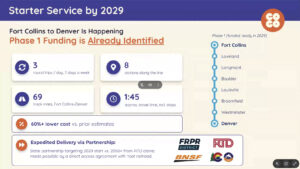
A graphic shows the map of starter service for the Front Range Passenger Rail.
That first pool of money will generate three round trips per day between Denver and Fort Collins, stopping also in, Loveland, Longmont, Boulder, Louisville, Broomfield and Westminster — at a cost of $332 million and operating expenses between $30 million and $60 million annually, Pace said. The cost is about 60% lower than originally estimated because of an agreement the district reached with the operators of two railroad tracks on which the train will run, he said.
By early next year, district leaders will be developing digital-control and automated-signaling systems to avoid collisions, then making improvements to railroad crossings, FRPR District board chairman John Putnam said during a Nov. 4 media briefing. By 2028, the district should begin building stations.
Those stations will not be dark, dingy or bland but should resemble smaller versions of Denver’s Union Station, complete with food and refreshment stands and other opportunities to incorporate local businesses, Pace said. The district is allocating $1.3 billion to host communities over the next 25 years not only to build out those areas but to ensure first- and last-mile service from scooters to cars to micro-buses to make it easy for people to get to the stations to use the train.
Second phase for Colorado Connector
The next nine stations, including stops at the new Denver Broncos and Denver Summit stations, are slated to come online in three additional phases through the end of 2031, stretching the line south through Littleton to Colorado Springs and Pueblo. This buildout will cost another $1.7 billion in addition to the station-construction price tag, and operating costs should be about $85 million to $116 million a year when it’s complete, Pace said.
The passengers will be a mix of intercity commuters for work and a larger host of people who may want to travel along the Front Range for a concert or a game or a trip home from college but wouldn’t be expected to use the train on a regular basis, Pace predicted. The cars, though older, will resemble the style of Amtrak Airo trains running on other intercity lines, allowing passengers to travel in comfort and relax as an alternative to driving a congested highway.
Keeping down the cost of tickets — district leaders are shooting for a roughly 19-cents-per-mile price tag, like that of the Colorado Department of Transportation’s Bustang service — will be key to attracting riders, officials believe. Pace noted that when the Winter Park Express train service cut its ticket cost in half several years ago, ridership increased by 130% year over year as people could see tangible benefits.
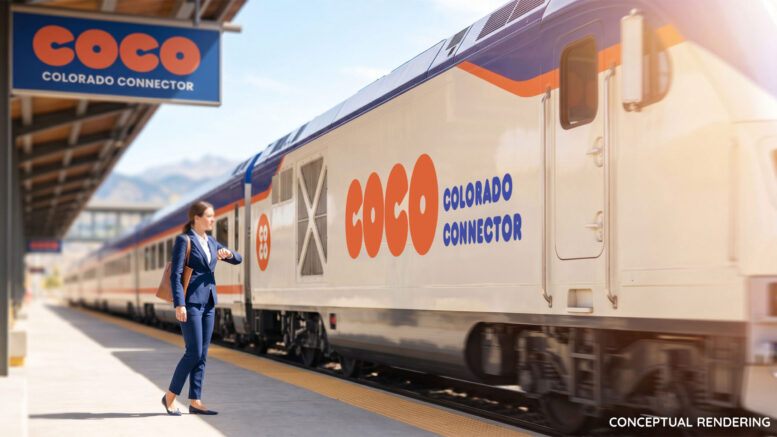
But even taking 3,500 cars a day off the I-25 corridor won’t move the needle much on the usability of a highway that business leaders dislike because of the uncertainty surrounding how long it may take to get employees to work or goods to a point of destination. As such, Front Range Passenger Rail supporters are hoping that the train, which has been nicknamed “CoCo,” can bring other benefits.
Could rail line reduce emissions?
One, hypothesized the Southwest Energy Efficiency Project in an Aug. 24 paper, is that the rail stations could catalyze mixed-use development around them, leading to construction of more energy-efficient residences and the need for individuals to take fewer vehicle trips. That shift in land use could cut emissions 6.6 times more than getting commuters out of cars alone, leading to a total reduction in 124,500 metric tons of greenhouse-gas emissions by 2045, the organization predicted.
“CoCo is one piece of a broader set of policies and investments to support more strategic growth near transit, and together these strategies increase the likelihood of development around stations,” authors Chandler Sanchez and Matt Frommer noted. They cited the 2024 law requiring cities to zone for more density around transit stations and a 2026 law allowing for tax-increment financing to support transit-oriented development as other factors that could boost this construction.
Pace points to the success of some other intercity trains — particularly the Mardi Gras Express running through Alabama, Mississippi and Louisiana — as well as the increasing consternation surrounding I-25 to justify his optimism that CoCo will attract riders. Once the district completes an agreement to move passengers seamlessly to an westbound train that CDOT is launching to take riders to places to mountain destinations like Steamboat Springs, residents and business owners should fully see the benefits of the rising sales tax.
“All transportation costs money. And what we’re going to be receiving is still going to pale in comparison to what we invest and what we should invest in highways,” Pace said. “I think if we really want to modernize Colorado, if we want to compete with other states … then I think we need to invest a little bit of money.”