At a time when “do no harm” has become the bar for success set by Colorado business leaders each legislative session, even that goal seemed lofty at the beginning of 2026. Increasing regulation, a costly emission-reductions proposal, an unbridgeable chasm on artificial-intelligence rules and another battle with labor loomed on the agenda.
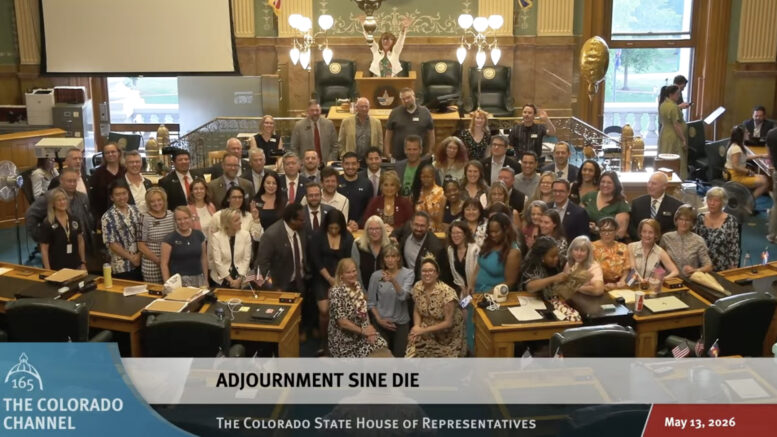
After 120 days of debate on subjects ranging from sports-arena hot-dog pricing to limits on rodenticide, however, it appears that business leaders not only reached the no-harm bar but exceeded it significantly.
Nearly every bill opposed vociferously by the business community ended up being killed or scaled back, with several major victories coming during the closing weeks of the session. Two measures that did pass could be headed for vetoes. And when business groups weren’t playing defense, they advanced proposals that will lead to regulatory reform, a streamlined workforce-development system and a rebooted environment for AI companies that had been holding off Colorado investments or pulling out of the state altogether.
Simply put, the 2026 legislative session was one where “do no harm” gave way to “do some good for job creators and economic development,” even in the state that ranks as the sixth-most regulated in America and the fourth-most expensive place to live.
AI rules reform a major factor in session
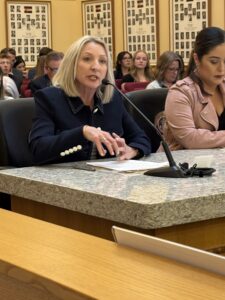
Colorado Chamber of Commerce President/CEO Loren Furman testifies for Senate Bill 137 in March before the Senate Finance Committee.
“I think it’s going to take a couple of years to start seeing some improvements in our rankings on a national basis, but this is a start,” said Colorado Chamber of Commerce President/CEO Loren Furman, who was front and center in many business debates. “And that’s why we’re so passionate about getting policies passed that put us on that trajectory.”
The bill that seemed to draw the most widespread praise in the immediate aftermath of the session that adjourned early Wednesday evening was the reform of Colorado’s yet-to-be-enacted, 2-year-old AI regulations that most parties called unworkable, Senate Bill 189. And just as difficult as the hefty disclosure requirements and burdensome appeals processes in that law were efforts made during much of 2024 and 2025 to find a fix for it, which resulted in three publicly negotiated overhaul bills dying for a lack of consensus.
So, Gov. Jared Polis called together a working group to meet behind closed doors for six months and got interests from Big Tech to the ACLU of Colorado to agree on a framework for what is still considered America’s most comprehensive AI regulatory policy. It mandates that consumers know when AI is used to make consequential decisions about them, allows them to appeal and correct data that the systems used, requires AI developers to work with deployers to ensure systems are used in a way that can avoid algorithmic bias and gives the Colorado Attorney General’s Office enforcement power.
“I’m proud of the work we accomplished this year to make our state more affordable, protect the core services that Coloradans rely on, as well as our ability to pass nation-leading legislation like my bill to establish a regulatory framework for AI systems,” said Colorado Senate Majority Leader Robert Rodriguez, D-Denver, who sponsored SB 189.
Other legislative wins for business leaders
Beyond the AI bill, businesses leaders took a big step toward regulatory reform with SB 137, which will require state agencies to review their regulations at least every five years and determine what may be outdated, redundant or missing the original intent of the law. Those reviews will have to be presented to legislative committees whose members can request sunset reviews to consider repeals of such rules or even audits of a program to determine what isn’t working.
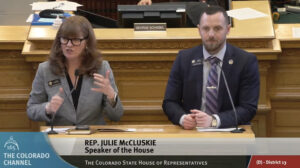
Colorado House Speaker Julie McCluskie and Minority Leader Jarvis Caldwell explain their regulatory review bill to the body last month.
It wasn’t just that the bill passed and is expected to be signed quickly into law by the Democratic governor, however. It was sponsored by the top Democratic and Republican leaders in each chamber, signaling the unifying belief that the state needs to reexamine its regulations at a time when more companies are choosing to expand elsewhere or relocate. And it wasn’t just one sector but a litany of leaders from bioscience, tech, hospitals, homebuilding and other areas of the economy that came together to ask for it.
Businesses also worked with Polis’ office and many educational leaders to pass House Bill 1317, which will put all the state’s workforce-development and higher-education initiatives under one department, streamlining the system for both learners and employers. And they lent their weight to several childcare reform efforts, including an extension of a popular tax credit and a winnowing of regulations that should make it more attractive for early childhood education centers to open and reduce the state’s childcare deserts.
Polis used heavy hand to influence legislative outcomes
“I would say this is the long game, and we have to continue to share the data, continue to talk about the challenges,” said Furman, whose organization issued a report this spring on jobs being relocated due in large part to regulatory or cost burdens. “And I know our state leaders, especially gubernatorial candidates, are looking at these reports and cost burdens and figuring out how they can be proactive on them.”

Gov. Jared Polis looks up toward the rafters of the Colorado House and applauds at a special guest he mentioned in January during his final State of the State Address.
Indeed, the specter of this being term-limited Gov. Polis’ final legislative session seemed to loom large over the lawmaking process, both in terms of bills that he encouraged and bills that he threatened to veto, several of which went to their deaths.
On Monday, sponsors asked the Senate Finance Committee to kill two bills that sought to roll back a combined $453 million in business tax breaks and put the money toward a new tax credit for lower-income families — because Polis warned them he wouldn’t sign the measures unless a portion of the new revenues went to lowering the state income-tax rate. Just a week before, those measures had sailed through the House by wide margins.
Polis made no secret that he was not a fan of a high-profile proposal that sought to require vendors in “captive-consumer” locations like airports and sports arenas price their goods at the average levels of the counties in which they’re located, and that business-opposed bill died in its first committee. Leaders of the Colorado Department of Labor and Employment opposed a Democratic effort to let the state impose new workplace-safety regulations if the federal Occupational Safety and Health Administration rolled back any rules, and that bill did not make it out of the Senate.
Governor gets some priorities blocked
The governor has said that he will again veto a labor-backed effort to eliminate the uniquely Colorado requirement for workers to have to hold a second election to achieve union security and allow union negotiating fees to be taken directly from paychecks — a declaration that made debates on HB 1005 almost anticlimactic this year. And he has hinted that he also could veto HB 1210, which would make Colorado the first state to ban the use of data gathered from internet surveillance to set individualized pricing of goods for consumers or wage offers for job seekers.
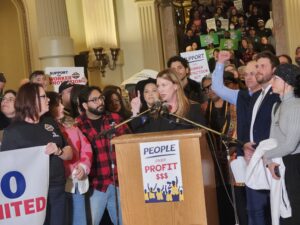
Colorado state Sen. Jessie Danielson speaks to a large group of union supporters in January about the need to rewrite the Colorado Labor Peace Act.
As much as the increasingly independent-minded governor pushed back on his own party, often with the help of business leaders, to stop what he thought were bad economic policies, though, he also found Democratic resistance to some of his own priorities.
Colorado Energy Office leaders spent much of the off-season preparing a proposal to speed up the requirements for utilities to achieve net-zero emissions by 10 years, to 2040, only to run into combined opposition from businesses, unions and utilities over what they feared would be burdensome costs and energy-sector job losses. That bill changed, over several draft versions, to become less mandatory and more permissive, and finally backers decided not to move it forward at all.
Polis also found continued early-session success in his push to encourage more affordable housing, signing measures that permit landholders like nonprofits and school districts to build with few restrictions on vacant properties they own up and that allow local governments to more actively fund housing. But later proposals to allow homeowners to split their lots by right to build more homes on them and to bar local governments from requiring minimum lot sizes of more than 2,000 feet died under pushback from cities and from local-control advocates.
Amendments reshaped key legislative proposals
Still, Polis declared Wednesday that he was pleased with the outcomes of the session.
“This session builds on eight years of hard work, lively debate, and meaningful progress,” Polis said in a news release boasting of successful bills like HB 1317 and the HOME Act allowing more organizations to build by right on their land. “Colorado has faced challenges, taken on the status quo, fought to protect personal freedom, strengthened our economy and found innovative and creative ways to save people money.”
Sometimes, success for business groups came not in the form of killing bills but in the form of changing them significantly.
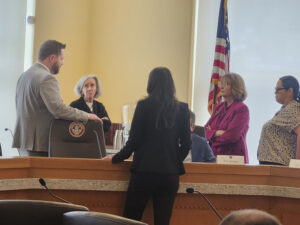
Colorado state Sens. Kyle Mullica (left) and Iman Jodeh (back to camera) heatedly discuss with members of the Joint Budget Committee a proposed amendment to their Senate Bill 178 by Sen. Barbara Kirkmeyer (purple jacket) that would limit spending by the Health Insurance Affordability Enterprise on May 6.
Aiming to keep afloat the Health Insurance Affordability Enterprise that funds the state’s reinsurance program and the OmniSalud program providing policies to undocumented immigrants, SB 178 sought to impose $40 million in new fees on health insurers. But when the industry pushed back, with Aetna owner CVS Health stating that members would see increases of $480 a year because of the fee, sponsors found another source of funding that didn’t involve increased costs to companies.
Several sectors got specific legislative wins
Under pressure from business leaders, particularly those on the Western Slope, sponsors of HB 1272, which seeks to protect workers from laboring in extreme heat or cold, changed that bill from a largely regulatory framework in 2025 to one focused on data collection this year. And when plastics manufacturers complained that a bill to minimize plastic pellet pollution, SB 16, banned them from disposing of the waste in landfills, Polis worked with the sponsors to introduce and pass another bill that removed that prohibition.
Agricultural businesses celebrated a highly successful session by defeating bills that sought to limit their use of common insecticides and rat poisons and getting a measure signed into law that increases the hourly threshold farm workers must meet before receiving overtime pay. And financial professionals celebrated when Polis signed a bill that offers more pathways for people to become a certified professional accountant, addressing the need for mid-career professionals to be able to achieve the certification while still working fulltime jobs.
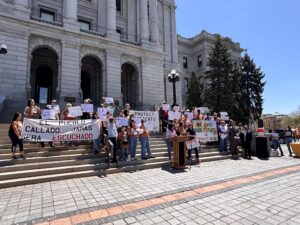
Annie Martínez, litigation director at the Colorado Center on Law & Policy, speaks at a rally on the west steps of the Capitol last week against legislators killing a bill to limit medical-debt collections.
Hospitals used the growing concern around their shaky finances, impacted by federal and state cutbacks on Medicaid funding, to kill two major proposals. One would have given the AG’s office more time-consuming power of review on sector mergers and acquisitions, and another would have limited medical debt-collection practices. The death of the debt-focused bill led activists to hold a rally last week in which they decried legislators bowing to the wishes of corporations more than patients.
Some losses go with the successes
To be sure, business leaders also suffered some setbacks this session.
With a ballot battle looming over a proposed constitutional amendment to shift some $700 million in general-fund revenues to road improvements, majority Democrats passed a late-session bill that would reduce existing funding by an equal amount, essentially leaving the new constitutional requirement a wash if it were to pass and avoiding cuts in other areas. An amendment added Monday to HB 1430 opens the door to the potential creation of a working group if backers drop their initiative, but that doesn’t appear likely right now.
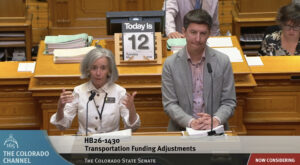
Colorado state Sens. Judy Amabile and William Lindstedt discuss House Bill 1430 in the Senate Tuesday.
And progressive Democrats pushed through an arbitration-reform measure that makes it easier to disqualify purportedly biased arbitrators and requires corporations who lose in arbitration to pay up more quickly. Employment attorneys argue that arbitration is a faster and cheaper way for most consumers or workers to deal with legal complaints, and they worry the bill will force more legal disputes into the already overcrowded court system.
But for all the worry that pervaded business circles at the start of the 2026 legislative session, it is clear that many sectors’ concerns were heard — by moderates, by pragmatic legislators alarmed by potential policy-related job losses, by Polis. And in that sense, the discussions and the pushback that marked these past 120 days are ones they hope can carry over into future sessions as well.