
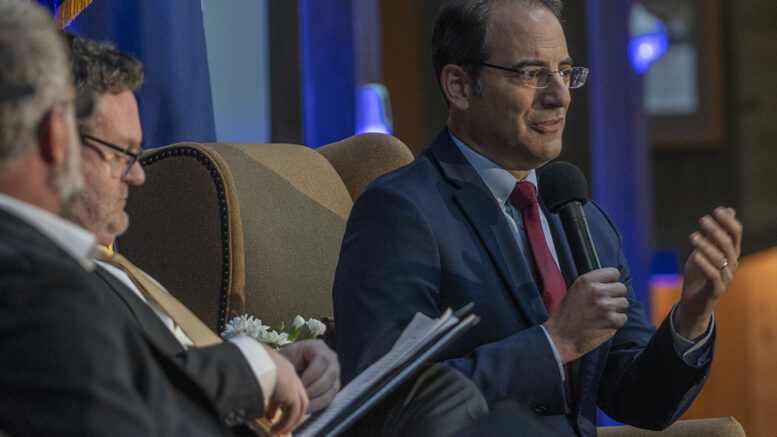
Democratic Attorney General Phil Weiser will be the next governor of Colorado after registering a landslide win Tuesday over Republican Victor Marx and Republican-turned-independent candidate Greg Lopez.
Weiser’s fellow Democrats seeking statewide office — Attorney General nominee Jena Griswold, Treasurer nominee Jeff Bridges and Secretary of State nominee Amanda Gonzalez — also cruised to victories by large margins, giving Dems a statewide sweep. While that continues full Democratic control of the constitutional offices that began in 2019, it also brings a change, as all four of the electees will be stepping into their respective offices for the first time.
Weiser succeeds term-limited fellow Democrat Jared Polis, but he is expected to bring a different viewpoint and deliberation style to the governor’s office. And he will have even more members of his own party in the Legislature to collaborate and sometimes clash with him as he seeks to implement his priorities for Colorado, as Democrats on Tuesday won a supermajority of seats in both the House and the Senate.
“I am going to be a Phil Weiser governor, not a third-term Jared Polis governor,” Weiser said during an interview last month on the “Colorado Chamber Office Hours” podcast. “If you have watched me as attorney general, what you will see is I am a deep believer in collaboration and problem-solving.”
What Weiser could mean for business
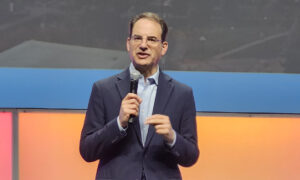
Colorado Attorney General Phil Weiser speaks at the “Building Colorado’s Future” gubernatorial forum in May.
Weiser’s priorities are wide-ranging, particularly when it comes to business issues. He wants to perform more cost-benefit analyses on existing and proposed regulations to try to speed up permitting throughout the state. He wants to build 40,000 new starter homes, focusing particularly on more widespread adoption of modular homes. And he believes Colorado can continue to reduce its use of fossil fuels without driving up utility bills.
In interviews and at the Colorado Chamber of Commerce gubernatorial forum last month, he’s repeatedly declined to be nailed down on a variety of issues, saying that he will enter significant conversations with stakeholders before outlining specific paths forward.
For instance, he said that he wants to update the Colorado Labor Peace Act to make it easier for labor unions to be able to take negotiating fees directly from all workers’ paychecks — but he hasn’t said exactly what changes must be in a bill for him to sign legislation that Polis vetoed twice. Similarly, he’s said that he wants greater child-protection regulations on social-media companies that Polis was not willing to sign, but he’s yet to outline exactly what new restrictions he believes are necessary, beyond saying chatbots need greater regulation.
A landslide victory
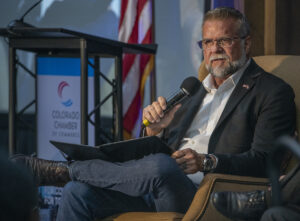
Republican gubernatorial nominee Victor Marx speaks at theColorado Chamber of Commerce gubernatorial forum.
But as he steps into office, Weiser will do so with a wider margin of support than Polis ever gained in his two races. As of 10 p.m., he led Marx, a ministry leader and first-time office seeker, by a margin of 61% to 33%. Lopez, a former U.S. representative from the 4th Congressional District, managed to garner only 3% percent of the vote.
Unlike in past gubernatorial contests, the race didn’t center on policy discussions. Marx, who eked out a somewhat surprising primary victory over Sen. Barbara Kirkmeyer, came under statewide and national scrutiny for his background, which included tales of how he said his abusive stepfather forced him to kill a man when he was a boy. He limited joint appearances with Weiser, though they demonstrated fairly wide gaps on several key policy issues during the Chamber forum.
One question Capitol observers will ask as Weiser prepares to take office in mid-January is how much he will stand up against a Democratic legislative caucus that moved to the left of Polis on numerous issues and generated dozens of vetoes from him the past two years. That caucus is likely to move further to the left in the upcoming session after progressive candidates defeated more moderate challengers in numerous primary races in June, including ousting a pair of moderate incumbents from safe Democratic House seats.
Will Weiser push back against progressive Democrats?
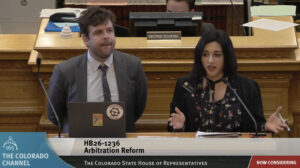
Colorado state Reps. Javier Mabrey and Yara Zokaie discuss their arbitration-reform bill in the House in April. The bill was one of several sponsored by more progressive Democrats that Gov. Jared Polis vetoed in 2026.
At the Chamber forum, Weiser, when asked how he will push back on his own party if it gains a supermajority, noted the amount of time he spent as attorney general in Republican areas like Mesa County and rural areas like the San Luis Valley. He didn’t answer the question directly but said he could set “as a cultural norm” the necessity of listening to minority-party members and understanding their concerns before he acts.
“What we need to make sure we build is a widespread appreciation to make sure that everyone is listened to. Regardless of where you are, regardless of your party, you matter to me,” Weiser said. “We need to respect you and make sure that your views are taken into account.”
Weiser sailed to his victory by winning not just in longtime Democratic population centers but also in traditionally Republican areas such as Weld, Douglas and El Paso counties. Marx captured 32 of Colorado’s 64 counties, but with the exception of Mesa County, almost all were lower-populated and more rural areas along the Eastern Plains and Western Slope as well as central Colorado regions like Park and Fremont counties.
The other statewide Democratic candidates won by margins that were only slightly smaller than Weiser’s.
Other Democrats score similar landslides

Sen. Jeff Bridges speaks about the budget proposal in the Senate in 2025.
Bridges, a state senator, defeated Kevin Grantham, the last Republican to serve as president of the Colorado Senate, by a margin of 59% to 39% to become the next state treasurer. He wants to expand the duties of the traditionally sleepy office by investing more state tax revenues in affordable housing and other local projects and by launching a forensic auditing unit that can proactively look at potentially problematic spending by other state agencies.
Gonzalez, currently the Jefferson County clerk and recorder, defeated Republican James Wiley, who advocated for more election transparency and opposed mail balloting, by a count of 60% to 37% to run the office that handles elections and business registrations. Gonzalez told The Sum & Substance she would like to make it easier for English-as-a-second-language speakers to be able to file business paperwork and hopes to bring in an innovation director to examine potential other steps to improve filing efficiency.
And in the closest of the four statewide races, voters picked Griswold, now the Colorado secretary of state, to become its next attorney general by a margin of 59% to 41% over Republican Michael Allen, the district attorney for El Paso and Teller counties. Griswold said she wants to continue Weiser’s legacy of filing lawsuits against what she called President Donald Trump’s overreach, and she wants to look at new ways the office could pursue law breakers, such as launching a unit specializing in wage-theft investigations.